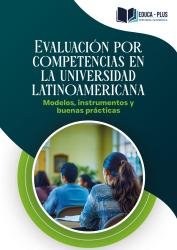
Evaluación por competencias en la universidad latinoamericana: Modelos, instrumentos y buenas prácticas
Palabras clave:
Evaluación por competencias, Educación superior, Evaluación educativa, Resultados de aprendizaje, Rúbricas, Evaluación auténtica, Retroalimentación, Inteligencia artificial educativaSinopsis
Evaluación por competencias en la universidad latinoamericana: Modelos, instrumentos y buenas prácticas aborda de manera integral los fundamentos, modelos, estrategias e instrumentos necesarios para fortalecer los procesos de evaluación en la educación superior. La obra analiza el tránsito desde una evaluación centrada principalmente en la reproducción de contenidos hacia enfoques orientados al desempeño, los resultados de aprendizaje y la movilización integrada de conocimientos, habilidades, actitudes y valores. Se examinan modelos de formación y evaluación por competencias, criterios e indicadores de logro, rúbricas, portafolios, listas de cotejo, escalas, proyectos, simulaciones y otras evidencias aplicables a distintos campos disciplinares. Asimismo, se profundiza en la evaluación auténtica, la retroalimentación, la autorregulación, la autoevaluación y la coevaluación, incorporando consideraciones sobre equidad, inclusión, transparencia e integridad académica. La obra también analiza el papel de la tecnología, la analítica del aprendizaje y la inteligencia artificial en los procesos evaluativos, así como sus implicaciones pedagógicas y éticas. Desde una perspectiva contextualizada en América Latina, el libro ofrece orientaciones para docentes, investigadores, coordinadores académicos, responsables de aseguramiento de la calidad y equipos de innovación educativa interesados en diseñar evaluaciones coherentes, pertinentes y orientadas al mejoramiento continuo del aprendizaje.
Referencias
Anderson, L. W., & Krathwohl, D. R. (Eds.). (2001). A taxonomy for learning, teaching, and assessing: A revision of Bloom's taxonomy of educational objectives. Longman.
Andrade, H. G. (2000). Using rubrics to promote thinking and learning. Educational Leadership, 57(5), 13–18.
Autio, C., et al. (2024). Artificial intelligence risk management framework: Generative artificial intelligence profile. NIST.
Biggs, J. (1996). Enhancing teaching through constructive alignment. Higher Education, 32, 347–364. https://doi.org/10.1007/BF00138871
Biggs, J., & Tang, C. (2011). Teaching for quality learning at university (4th ed.). Open University Press.
Black, P., & Wiliam, D. (1998). Assessment and classroom learning. Assessment in Education: Principles, Policy & Practice, 5(1), 7–74. https://doi.org/10.1080/0969595980050102
Boud, D., & Falchikov, N. (Eds.). (2007). Rethinking assessment in higher education: Learning for the longer term. Routledge.
Boud, D., & Molloy, E. (Eds.). (2013). Feedback in higher and professional education: Understanding it and doing it well. Routledge.
Brookhart, S. M. (2013). How to create and use rubrics for formative assessment and grading. ASCD.
Cano García, M. E. (2008). La evaluación por competencias en la educación superior. Profesorado. Revista de Currículum y Formación del Profesorado, 12(3), 1–16.
Carless, D., & Boud, D. (2018). The development of student feedback literacy. Assessment & Evaluation in Higher Education, 43(8), 1315–1325.
CINDA. (2014). Evaluación del aprendizaje en innovaciones curriculares de la educación superior. Centro Interuniversitario de Desarrollo.
European Commission. (2018). Council recommendation on key competences for lifelong learning. Publications Office of the European Union.
European Parliament and Council. (2024). Regulation (EU) 2024/1689 laying down harmonised rules on artificial intelligence.
Ferguson, R. (2012). Learning analytics: Drivers, developments and challenges. International Journal of Technology Enhanced Learning, 4(5/6), 304–317.
González, J., & Wagenaar, R. (Eds.). (2003). Tuning educational structures in Europe. University of Deusto.
Gulikers, J. T. M., Bastiaens, T. J., & Kirschner, P. A. (2004). A five-dimensional framework for authentic assessment. Educational Technology Research and Development, 52(3), 67–86. https://doi.org/10.1007/BF02504676
Harden, R. M. (2007). Outcome-based education: The ostrich, the peacock and the beaver. Medical Teacher, 29(7), 666–671. https://doi.org/10.1080/01421590701729948
Hattie, J., & Timperley, H. (2007). The power of feedback. Review of Educational Research, 77(1), 81–112.
Herrington, J., & Herrington, A. (Eds.). (2006). Authentic learning environments in higher education. Information Science Publishing.
Jonsson, A., & Svingby, G. (2007). The use of scoring rubrics: Reliability, validity and educational consequences. Educational Research Review, 2(2), 130–144.
Kennedy, D., Hyland, Á., & Ryan, N. (2007). Writing and using learning outcomes: A practical guide. In E. Froment et al. (Eds.), EUA Bologna handbook. Raabe.
Messick, S. (1995). Validity of psychological assessment: Validation of inferences from persons' responses and performances as scientific inquiry into score meaning. American Psychologist, 50(9), 741–749. https://doi.org/10.1037/0003-066X.50.9.741
Miao, F., & Holmes, W. (2023). Guidance for generative AI in education and research. UNESCO.
Miller, G. E. (1990). The assessment of clinical skills, competence, performance. Academic Medicine, 65(9), S63–S67.
Moon, J. (2002). The module and programme development handbook: A practical guide to linking levels, learning outcomes and assessment. Kogan Page.
Mueller, J. (2018). Authentic assessment toolbox. North Central College.
National Institute of Standards and Technology. (2023). Artificial intelligence risk management framework, AI RMF 1.0. NIST.
Nicol, D. J., & Macfarlane Dick, D. (2006). Formative assessment and self regulated learning: A model and seven principles of good feedback practice. Studies in Higher Education, 31(2), 199–218.
Nusche, D. (2008). Assessment of learning outcomes in higher education: A comparative review of selected practices. OECD Education Working Papers, No. 15. OECD Publishing. https://doi.org/10.1787/244257272573
OECD. (2022). Does higher education teach students to think critically? OECD Publishing.
OECD. (2023). Innovating assessments to measure and support complex skills. OECD Publishing. https://doi.org/10.1787/e5f3e341-en
Panadero, E., & Jonsson, A. (2013). The use of scoring rubrics for formative assessment purposes revisited. Educational Research Review, 9, 129–144.
Panadero, E., Andrade, H., & Brookhart, S. M. (2018). Fusing self regulated learning and formative assessment. Educational Research Review, 24, 172–194.
Sadler, D. R. (1987). Specifying and promulgating achievement standards. Oxford Review of Education, 13(2), 191–209. https://doi.org/10.1080/0305498870130207
Sadler, D. R. (1989). Formative assessment and the design of instructional systems. Instructional Science, 18, 119–144.
Savery, J. R. (2006). Overview of problem based learning: Definitions and distinctions. Interdisciplinary Journal of Problem Based Learning, 1(1), 9–20.
Siemens, G., & Long, P. (2011). Penetrating the fog: Analytics in learning and education. EDUCAUSE Review, 46(5), 30–40.
Slade, S., & Prinsloo, P. (2013). Learning analytics: Ethical issues and dilemmas. American Behavioral Scientist, 57(10), 1510–1529.
Spady, W. G. (1994). Outcome-based education: Critical issues and answers. American Association of School Administrators.
Tai, J., Ajjawi, R., Boud, D., Dawson, P., & Panadero, E. (2018). Developing evaluative judgement. Higher Education, 76, 467–481.
Tardif, J. (2006). L’évaluation des compétences: Documenter le parcours de développement. Chenelière Éducation.
Tuning Academy. (2014). Meta-profiles and profiles: A new approach for degrees in Latin America. University of Deusto.
UNESCO. (2021). Recommendation on the ethics of artificial intelligence. UNESCO.
UNESCO. (2022). Education in Latin America and the Caribbean at a crossroads: Regional monitoring report SDG4 Education 2030. UNESCO.
UNESCO. (2024). AI competency framework for teachers. UNESCO.
van der Vleuten, C. P. M., Schuwirth, L. W. T., Driessen, E. W., Govaerts, M. J. B., & Heeneman, S. (2012). Twelve tips for programmatic assessment. Medical Teacher, 34(3), 205–214.
Wiggins, G. (1998). Educative assessment: Designing assessments to inform and improve student performance. Jossey-Bass.
Zimmerman, B. J. (2002). Becoming a self regulated learner: An overview. Theory Into Practice, 41(2), 64–70.
Descargas
Publicado
Colección
Licencia

Esta obra está bajo una licencia internacional Creative Commons Atribución-NoComercial-CompartirIgual 4.0.
Política de Derechos de Autor y Licencia de Publicación
Los autores conservan la titularidad de los derechos de autor de sus obras publicadas en EDUCA-PLUS Editorial Académica. Al aceptar la publicación de su manuscrito, conceden a la editorial una licencia no exclusiva para editar, publicar, distribuir, preservar y difundir la obra en formato impreso y digital.
Salvo indicación expresa en contrario, las publicaciones se distribuyen bajo la licencia Creative Commons Reconocimiento-No Comercial- Compartir Igual 4.0 Internacional(CC BY-NC-SA 4.0), que permite copiar, compartir, adaptar y reutilizar el contenido para cualquier propósito, incluso comercial, siempre que se otorgue el reconocimiento adecuado a los autores y a la fuente original de publicación.