
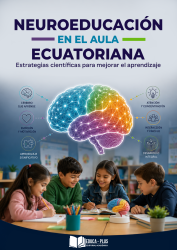
Neuroeducación en el aula ecuatoriana: Estrategias científicas para potenciar el aprendizaje
Palabras clave:
aprendizaje significativo, desarrollo cerebral, educación básica, estrategias pedagógicas, inclusión educativa, neuroeducación, neurociencia educativaSinopsis
Neuroeducación en el aula ecuatoriana presenta una aproximación pedagógica y contextualizada al funcionamiento del cerebro durante el aprendizaje en la educación básica. La obra integra aportes de la neurociencia, la psicología y la pedagogía para explicar procesos como la neuroplasticidad, la atención, la memoria, las emociones, la motivación y el desarrollo cerebral infantil. Asimismo, analiza la neurodiversidad, las dificultades de aprendizaje y los principios de la educación inclusiva, ofreciendo orientaciones fundamentadas para responder a las necesidades de cada estudiante. A través de ejemplos situados en el contexto ecuatoriano, propone estrategias aplicables a distintas áreas curriculares, actividades para fortalecer el aprendizaje significativo y recursos para crear ambientes seguros. El libro desarrolla el perfil y las competencias del docente neuroeducador del siglo XXI, destacando su liderazgo, empatía, bienestar y formación continua. Constituye una guía práctica para docentes, investigadores, directivos y profesionales comprometidos con una educación inclusiva, humana y basada en evidencia científica.
Referencias
American Psychiatric Association. (2013). Diagnostic and statistical manual of mental disorders (5th ed.). https://doi.org/10.1176/appi.books.9780890425596
Anderson, L. W., & Krathwohl, D. R. (Eds.). (2001). A taxonomy for learning, teaching, and assessing: A revision of Bloom’s taxonomy of educational objectives. Longman.
Armstrong, T. (2012). Neurodiversity in the classroom: Strength-based strategies to help students with special needs succeed in school and life. ASCD.
Asamblea Nacional del Ecuador. (2011). Ley Orgánica de Educación Intercultural. Registro Oficial Suplemento 417.
Atkinson, R. C., & Shiffrin, R. M. (1968). Human memory: A proposed system and its control processes. In K. W. Spence & J. T. Spence (Eds.), The psychology of learning and motivation (Vol. 2, pp. 89–195). Academic Press. https://doi.org/10.1016/S0079-7421(08)60422-3
Ausubel, D. P. (1963). The psychology of meaningful verbal learning. Grune & Stratton.
Ausubel, D. P. (1968). Educational psychology: A cognitive view. Holt, Rinehart and Winston.
Ausubel, D. P., Novak, J. D., & Hanesian, H. (1978). Educational psychology: A cognitive view (2nd ed.). Holt, Rinehart and Winston.
Baddeley, A. D. (1986). Working memory. Oxford University Press.
Baddeley, A. D. (2000). The episodic buffer: A new component of working memory? Trends in Cognitive Sciences, 4(11), 417–423. https://doi.org/10.1016/S1364-6613(00)01538-2
Barkley, R. A. (2015). Attention-deficit hyperactivity disorder: A handbook for diagnosis and treatment (4th ed.). Guilford Press.
Barrett, P., Zhang, Y., Moffat, J., & Kobbacy, K. (2013). A holistic, multi-level analysis identifying the impact of classroom design on pupils’ learning. Building and Environment, 59, 678–689. https://doi.org/10.1016/j.buildenv.2012.09.016
Battro, A. M., Fischer, K. W., & Léna, P. J. (Eds.). (2008). The educated brain: Essays in neuroeducation. Cambridge University Press.
Beilock, S. L. (2008). Math performance in stressful situations. Current Directions in Psychological Science, 17(5), 339–343. https://doi.org/10.1111/j.1467-8721.2008.00602.x
Blakemore, S.-J., & Frith, U. (2005). The learning brain: Lessons for education. Blackwell Publishing.
Boaler, J. (2016). Mathematical mindsets: Unleashing students’ potential through creative math, inspiring messages and innovative teaching. Jossey-Bass.
Bowlby, J. (1969). Attachment and loss: Vol. 1. Attachment. Basic Books.
Brown, S. (2009). Play: How it shapes the brain, opens the imagination, and invigorates the soul. Avery.
Bybee, R. W., Taylor, J. A., Gardner, A., Van Scotter, P., Powell, J. C., Westbrook, A., & Landes, N. (2006). The BSCS 5E instructional model: Origins and effectiveness. BSCS.
CAST. (2018). Universal design for learning guidelines version 2.2. http://udlguidelines.cast.org
Cepeda, N. J., Pashler, H., Vul, E., Wixted, J. T., & Rohrer, D. (2006). Distributed practice in verbal recall tasks: A review and quantitative synthesis. Psychological Bulletin, 132(3), 354–380. https://doi.org/10.1037/0033-2909.132.3.354
Chabris, C. F. (1999). Prelude or requiem for the “Mozart effect”? Nature, 400, 826–827. https://doi.org/10.1038/23608
Chi, M. T. H., Bassok, M., Lewis, M. W., Reimann, P., & Glaser, R. (1989). Self-explanations: How students study and use examples in learning to solve problems. Cognitive Science, 13(2), 145–182. https://doi.org/10.1207/s15516709cog1302_1
Craik, F. I. M., & Lockhart, R. S. (1972). Levels of processing: A framework for memory research. Journal of Verbal Learning and Verbal Behavior, 11(6), 671–684. https://doi.org/10.1016/S0022-5371(72)80001-X
Csikszentmihalyi, M. (1990). Flow: The psychology of optimal experience. Harper & Row.
Curcio, G., Ferrara, M., & De Gennaro, L. (2006). Sleep loss, learning capacity and academic performance. Sleep Medicine Reviews, 10(5), 323–337. https://doi.org/10.1016/j.smrv.2005.11.001
Dale, E. (1969). Audio-visual methods in teaching (3rd ed.). Holt, Rinehart and Winston.
Damasio, A. R. (1994). Descartes’ error: Emotion, reason, and the human brain. Putnam.
Damasio, A. R. (2018). The strange order of things: Life, feeling, and the making of cultures. Pantheon Books.
Darling-Hammond, L. (2017). Teacher education around the world: What can we learn from international practice? European Journal of Teacher Education, 40(3), 291–309. https://doi.org/10.1080/02619768.2017.1315399
Darling-Hammond, L., Hyler, M. E., & Gardner, M. (2017). Effective teacher professional development. Learning Policy Institute. https://doi.org/10.54300/122.311
Dehaene, S. (2009). Reading in the brain: The new science of how we read. Viking.
Dehaene, S. (2011). The number sense: How the mind creates mathematics (Rev. ed.). Oxford University Press.
Dehaene, S. (2019). How we learn: Why brains learn better than any machine... for now. Viking.
Dekker, S., Lee, N. C., Howard-Jones, P., & Jolles, J. (2012). Neuromyths in education: Prevalence and predictors of misconceptions among teachers. Frontiers in Psychology, 3, Article 429. https://doi.org/10.3389/fpsyg.2012.00429
Diamond, A. (2013). Executive functions. Annual Review of Psychology, 64, 135–168. https://doi.org/10.1146/annurev-psych-113011-143750
Durlak, J. A., Weissberg, R. P., Dymnicki, A. B., Taylor, R. D., & Schellinger, K. B. (2011). The impact of enhancing students’ social and emotional learning: A meta-analysis of school-based universal interventions. Child Development, 82(1), 405–432. https://doi.org/10.1111/j.1467-8624.2010.01564.x
Dweck, C. S. (2006). Mindset: The new psychology of success. Random House.
Ebbinghaus, H. (1913). Memory: A contribution to experimental psychology (H. A. Ruger & C. E. Bussenius, Trans.). Teachers College, Columbia University. (Original work published 1885)
Eide, B. L., & Eide, F. F. (2011). The dyslexic advantage: Unlocking the hidden potential of the dyslexic brain. Hudson Street Press.
Elliott, J. (1991). Action research for educational change. Open University Press.
Fisher, A. V., Godwin, K. E., & Seltman, H. (2014). Visual environment, attention allocation, and learning in young children: When too much of a good thing may be bad. Psychological Science, 25(7), 1362–1370. https://doi.org/10.1177/0956797614533801
Flook, L., Goldberg, S. B., Pinger, L., & Davidson, R. J. (2015). Promoting prosocial behavior and self-regulatory skills in preschool children through a mindfulness-based kindness curriculum. Developmental Psychology, 51(1), 44–51. https://doi.org/10.1037/a0038256
Gardner, H. (1983). Frames of mind: The theory of multiple intelligences. Basic Books.
Gleichgerrcht, E., Luttges, B. L., Salvarezza, F., & Campos, A. L. (2015). Educational neuromyths among teachers in Latin America. Mind, Brain, and Education, 9(3), 170–178. https://doi.org/10.1111/mbe.12086
Goleman, D. (1995). Emotional intelligence: Why it can matter more than IQ. Bantam Books.
Goleman, D., Boyatzis, R., & McKee, A. (2002). Primal leadership: Realizing the power of emotional intelligence. Harvard Business School Press.
Grantham-McGregor, S., Cheung, Y. B., Cueto, S., Glewwe, P., Richter, L., & Strupp, B. (2007). Developmental potential in the first 5 years for children in developing countries. The Lancet, 369(9555), 60–70. https://doi.org/10.1016/S0140-6736(07)60032-4
Hamre, B. K., & Pianta, R. C. (2001). Early teacher–child relationships and the trajectory of children’s school outcomes through eighth grade. Child Development, 72(2), 625–638. https://doi.org/10.1111/1467-8624.00301
Hargreaves, A., & Fullan, M. (2012). Professional capital: Transforming teaching in every school. Teachers College Press.
Hattie, J. (2009). Visible learning: A synthesis of over 800 meta-analyses relating to achievement. Routledge.
Hattie, J. (2012). Visible learning for teachers: Maximizing impact on learning. Routledge.
Hattie, J., & Timperley, H. (2007). The power of feedback. Review of Educational Research, 77(1), 81–112. https://doi.org/10.3102/003465430298487
Hebb, D. O. (1949). The organization of behavior: A neuropsychological theory. Wiley.
Howard-Jones, P. A. (2014). Neuroscience and education: Myths and messages. Nature Reviews Neuroscience, 15(12), 817–824. https://doi.org/10.1038/nrn3817
Hölzel, B. K., Carmody, J., Vangel, M., Congleton, C., Yerramsetti, S. M., Gard, T., & Lazar, S. W. (2011). Mindfulness practice leads to increases in regional brain gray matter density. Psychiatry Research: Neuroimaging, 191(1), 36–43. https://doi.org/10.1016/j.pscychresns.2010.08.006
Hyde, K. L., Lerch, J., Norton, A., Forgeard, M., Winner, E., Evans, A. C., & Schlaug, G. (2009). Musical training shapes structural brain development. Journal of Neuroscience, 29(10), 3019–3025. https://doi.org/10.1523/JNEUROSCI.5118-08.2009
Immordino-Yang, M. H. (2016). Emotions, learning, and the brain: Exploring the educational implications of affective neuroscience. W. W. Norton & Company.
Immordino-Yang, M. H., & Damasio, A. R. (2007). We feel, therefore we learn: The relevance of affective and social neuroscience to education. Mind, Brain, and Education, 1(1), 3–10. https://doi.org/10.1111/j.1751-228X.2007.00004.x
James, K. H., & Engelhardt, L. (2012). The effects of handwriting experience on functional brain development in pre-literate children. Trends in Neuroscience and Education, 1(1), 32–42. https://doi.org/10.1016/j.tine.2012.08.001
Kabat-Zinn, J. (2003). Mindfulness-based interventions in context: Past, present, and future. Clinical Psychology: Science and Practice, 10(2), 144–156. https://doi.org/10.1093/clipsy.bpg016
Kandel, E. R. (2006). In search of memory: The emergence of a new science of mind. W. W. Norton & Company.
LeDoux, J. (1996). The emotional brain: The mysterious underpinnings of emotional life. Simon & Schuster.
LeDoux, J. (2015). Anxious: Using the brain to understand and treat fear and anxiety. Viking.
Levitin, D. J. (2006). This is your brain on music: The science of a human obsession. Dutton.
Lieberman, M. D., Eisenberger, N. I., Crockett, M. J., Tom, S. M., Pfeifer, J. H., & Way, B. M. (2007). Putting feelings into words: Affect labeling disrupts amygdala activity in response to affective stimuli. Psychological Science, 18(5), 421–428. https://doi.org/10.1111/j.1467-9280.2007.01916.x
Lozoff, B., Jimenez, E., & Smith, J. B. (2006). Double burden of iron deficiency in infancy and low socioeconomic status: A longitudinal analysis of cognitive test scores to age 19 years. Archives of Pediatrics & Adolescent Medicine, 160(11), 1108–1113. https://doi.org/10.1001/archpedi.160.11.1108
Lupien, S. J., McEwen, B. S., Gunnar, M. R., & Heim, C. (2009). Effects of stress throughout the lifespan on the brain, behaviour and cognition. Nature Reviews Neuroscience, 10(6), 434–445. https://doi.org/10.1038/nrn2639
Manes, F., & Niro, M. (2014). Usar el cerebro: Conocer nuestra mente para vivir mejor. Planeta.
Mayer, R. E. (2009). Multimedia learning (2nd ed.). Cambridge University Press.
McEwen, B. S. (2008). Central effects of stress hormones in health and disease: Understanding the protective and damaging effects of stress and stress mediators. European Journal of Pharmacology, 583(2–3), 174–185. https://doi.org/10.1016/j.ejphar.2007.11.071
Merzenich, M. M. (2013). Soft-wired: How the new science of brain plasticity can change your life. Parnassus Publishing.
Miller, G. A. (1956). The magical number seven, plus or minus two: Some limits on our capacity for processing information. Psychological Review, 63(2), 81–97. https://doi.org/10.1037/h0043158
Ministerio de Educación del Ecuador. (2013). Acuerdo Ministerial 0295-13: Normativa referente a la atención a los estudiantes con necesidades educativas especiales en establecimientos de educación ordinaria o en instituciones educativas especializadas. https://educacion.gob.ec
Ministerio de Educación del Ecuador. (2016). Currículo de los niveles de educación obligatoria. https://educacion.gob.ec/curriculo/
Ministerio de Educación del Ecuador. (2016). Instructivo para la evaluación y promoción de estudiantes con necesidades educativas especiales. https://educacion.gob.ec
Ministerio de Educación del Ecuador. (2020). Instructivo para la evaluación estudiantil. https://educacion.gob.ec/evaluacion-estudiantil/
Ministerio de Educación del Ecuador. (2021). Currículo priorizado con énfasis en competencias comunicacionales, matemáticas, digitales y socioemocionales. https://recursos.educacion.gob.ec/red/curriculo/
Ministerio de Educación del Ecuador. (2021). Guía de implementación del currículo de educación general básica. https://educacion.gob.ec/curriculo/
Ministerio de Educación del Ecuador. (2022). Programa de educación socioemocional para la educación general básica. https://educacion.gob.ec
Ministerio de Educación del Ecuador. (2023). Protocolo de actuación frente a situaciones de necesidades educativas especiales. https://educacion.gob.ec
Ministerio de Educación del Ecuador. (2024). Plan Nacional de Formación Permanente. https://educacion.gob.ec/wp-content/uploads/downloads/2024/03/Plan-Nacional-de-Formacion-Permanente.pdf
Mora, F. (2013). Neuroeducación: Solo se puede aprender aquello que se ama. Alianza Editorial.
Mora, F. (2017). Cómo funciona el cerebro. Alianza Editorial.
Moser, J. S., Schroder, H. S., Heeter, C., Moran, T. P., & Lee, Y. H. (2011). Mind your errors: Evidence for a neural mechanism linking growth mind-set to adaptive posterror adjustments. Psychological Science, 22(12), 1484–1489. https://doi.org/10.1177/0956797611419520
Nielsen, J. A., Zielinski, B. A., Ferguson, M. A., Lainhart, J. E., & Anderson, J. S. (2013). An evaluation of the left-brain vs. right-brain hypothesis with resting state functional connectivity magnetic resonance imaging. PLOS ONE, 8(8), Article e71275. https://doi.org/10.1371/journal.pone.0071275
Novak, J. D. (1998). Learning, creating, and using knowledge: Concept maps as facilitative tools in schools and corporations. Lawrence Erlbaum Associates.
Ophir, E., Nass, C., & Wagner, A. D. (2009). Cognitive control in media multitaskers. Proceedings of the National Academy of Sciences, 106(37), 15583–15587. https://doi.org/10.1073/pnas.0903620106
Organización Internacional del Trabajo. (2020). Education and training. https://www.ilo.org/topics-and-sectors/industries-and-sectors/education-and-training
Organización Panamericana de la Salud. (2018). La carga de los trastornos mentales en la Región de las Américas, 2018. OPS. https://iris.paho.org/handle/10665.2/49578
Organización para la Cooperación y el Desarrollo Económicos. (2002). Understanding the brain: Towards a new learning science. OECD Publishing. https://doi.org/10.1787/9789264174986-en
Organización para la Cooperación y el Desarrollo Económicos. (2007). Understanding the brain: The birth of a learning science. OECD Publishing. https://doi.org/10.1787/9789264029132-en
Organización para la Cooperación y el Desarrollo Económicos. (2019). TALIS 2018 results: Teachers and school leaders as lifelong learners (Vol. 1). OECD Publishing. https://doi.org/10.1787/1d0bc92a-en
Paivio, A. (1991). Dual coding theory: Retrospect and current status. Canadian Journal of Psychology / Revue canadienne de psychologie, 45(3), 255–287. https://doi.org/10.1037/h0084295
Paruthi, S., Brooks, L. J., D’Ambrosio, C., Hall, W. A., Kotagal, S., Lloyd, R. M., Malow, B. A., Maski, K., Nichols, C., Quan, S. F., Rosen, C. L., Troester, M. M., & Wise, M. S. (2016). Recommended amount of sleep for pediatric populations: A consensus statement of the American Academy of Sleep Medicine. Journal of Clinical Sleep Medicine, 12(6), 785–786. https://doi.org/10.5664/jcsm.5866
Pashler, H., McDaniel, M., Rohrer, D., & Bjork, R. (2008). Learning styles: Concepts and evidence. Psychological Science in the Public Interest, 9(3), 105–119. https://doi.org/10.1111/j.1539-6053.2009.01038.x
Pellis, S. M., & Pellis, V. C. (2009). The playful brain: Venturing to the limits of neuroscience. Oneworld Publications.
Polanczyk, G. V., Salum, G. A., Sugaya, L. S., Caye, A., & Rohde, L. A. (2015). Annual research review: A meta-analysis of the worldwide prevalence of mental disorders in children and adolescents. Journal of Child Psychology and Psychiatry, 56(3), 345–365. https://doi.org/10.1111/jcpp.12381
Posner, M. I., & Rothbart, M. K. (2007). Research on attention networks as a model for the integration of psychological science. Annual Review of Psychology, 58, 1–23. https://doi.org/10.1146/annurev.psych.58.110405.085516
Presidencia de la República del Ecuador. (2023). Reglamento General a la Ley Orgánica de Educación Intercultural. Registro Oficial Segundo Suplemento 254. https://www.gob.ec/regulaciones/reglamento-general-ley-organica-educacion-intercultural-0
Ratey, J. J., & Hagerman, E. (2008). Spark: The revolutionary new science of exercise and the brain. Little, Brown and Company.
Rauscher, F. H., Shaw, G. L., & Ky, K. N. (1993). Music and spatial task performance. Nature, 365(6447), 611. https://doi.org/10.1038/365611a0
Rizzolatti, G., Fadiga, L., Gallese, V., & Fogassi, L. (1996). Premotor cortex and the recognition of motor actions. Cognitive Brain Research, 3(2), 131–141. https://doi.org/10.1016/0926-6410(95)00038-0
Robinson, K. (2011). Out of our minds: Learning to be creative (2nd ed.). Capstone.
Roediger, H. L., & Karpicke, J. D. (2006). Test-enhanced learning: Taking memory tests improves long-term retention. Psychological Science, 17(3), 249–255. https://doi.org/10.1111/j.1467-9280.2006.01693.x
Rose, D. H., & Meyer, A. (2002). Teaching every student in the digital age: Universal design for learning. ASCD.
Rose, T. (2016). The end of average: How we succeed in a world that values sameness. HarperOne.
Rosen, L. D., Lim, A. F., Carrier, L. M., & Cheever, N. A. (2011). An empirical examination of the educational impact of text message-induced task switching in the classroom: Educational implications and strategies to enhance learning. Psicología Educativa, 17(2), 163–177. https://doi.org/10.5093/ed2011v17n2a4
Schacter, D. L. (2001). The seven sins of memory: How the mind forgets and remembers. Houghton Mifflin.
Schultz, W., Dayan, P., & Montague, P. R. (1997). A neural substrate of prediction and reward. Science, 275(5306), 1593–1599. https://doi.org/10.1126/science.275.5306.1593
Shaw, P., Eckstrand, K., Sharp, W., Blumenthal, J., Lerch, J. P., Greenstein, D., Clasen, L., Evans, A., Giedd, J., & Rapoport, J. L. (2007). Attention-deficit/hyperactivity disorder is characterized by a delay in cortical maturation. Proceedings of the National Academy of Sciences, 104(49), 19649–19654. https://doi.org/10.1073/pnas.0707741104
Shaywitz, S. (2003). Overcoming dyslexia: A new and complete science-based program for reading problems at any level. Knopf.
Siegel, D. J. (2012). The developing mind: How relationships and the brain interact to shape who we are (2nd ed.). Guilford Press.
Silverman, L. K. (2002). Upside-down brilliance: The visual-spatial learner. DeLeon Publishing.
Sousa, D. A. (2017). How the brain learns (5th ed.). Corwin Press.
Stansfeld, S. A., & Matheson, M. P. (2003). Noise pollution: Non-auditory effects on health. British Medical Bulletin, 68(1), 243–257. https://doi.org/10.1093/bmb/ldg033
Stenhouse, L. (1975). An introduction to curriculum research and development. Heinemann.
Stickgold, R. (2005). Sleep-dependent memory consolidation. Nature, 437(7063), 1272–1278. https://doi.org/10.1038/nature04286
Sweller, J. (1988). Cognitive load during problem solving: Effects on learning. Cognitive Science, 12(2), 257–285. https://doi.org/10.1207/s15516709cog1202_4
Universidad Nacional de Educación del Ecuador. (2024). Programa de especialización en neuroeducación y aprendizaje. https://www.unae.edu.ec/programas/
Vygotsky, L. S. (1978). Mind in society: The development of higher psychological processes. Harvard University Press.
Wagner, U., Gais, S., Haider, H., Verleger, R., & Born, J. (2004). Sleep inspires insight. Nature, 427(6972), 352–355. https://doi.org/10.1038/nature02223
Walker, M. (2017). Why we sleep: Unlocking the power of sleep and dreams. Scribner.
Willis, J. (2006). Research-based strategies to ignite student learning: Insights from a neurologist and classroom teacher. ASCD.
Willis, J. (2010). Learning to love math: Teaching strategies that change student attitudes and get results. ASCD.
Wolf, M. (2007). Proust and the squid: The story and science of the reading brain. Harper.
Wolf, M. (2018). Reader, come home: The reading brain in a digital world. Harper.
Wood, D., Bruner, J. S., & Ross, G. (1976). The role of tutoring in problem solving. Journal of Child Psychology and Psychiatry, 17(2), 89–100. https://doi.org/10.1111/j.1469-7610.1976.tb00381.x
Zenner, C., Herrnleben-Kurz, S., & Walach, H. (2014). Mindfulness-based interventions in schools: A systematic review and meta-analysis. Frontiers in Psychology, 5, Article 603. https://doi.org/10.3389/fpsyg.2014.00603
Descargas
Publicado
Colección
Licencia

Esta obra está bajo una licencia internacional Creative Commons Atribución-NoComercial-CompartirIgual 4.0.
Política de Derechos de Autor y Licencia de Publicación
Los autores conservan la titularidad de los derechos de autor de sus obras publicadas en EDUCA-PLUS Editorial Académica. Al aceptar la publicación de su manuscrito, conceden a la editorial una licencia no exclusiva para editar, publicar, distribuir, preservar y difundir la obra en formato impreso y digital.
Salvo indicación expresa en contrario, las publicaciones se distribuyen bajo la licencia Creative Commons Reconocimiento-No Comercial- Compartir Igual 4.0 Internacional(CC BY-NC-SA 4.0), que permite copiar, compartir, adaptar y reutilizar el contenido para cualquier propósito, incluso comercial, siempre que se otorgue el reconocimiento adecuado a los autores y a la fuente original de publicación.